
Technology & integration

Connecting the technology modern care depends on.

Care management tools, AI-assisted monitoring, nurse call, staff devices and building systems all rely on the network underneath them. We design that network around their requirements and work through the technical detail with each supplier.

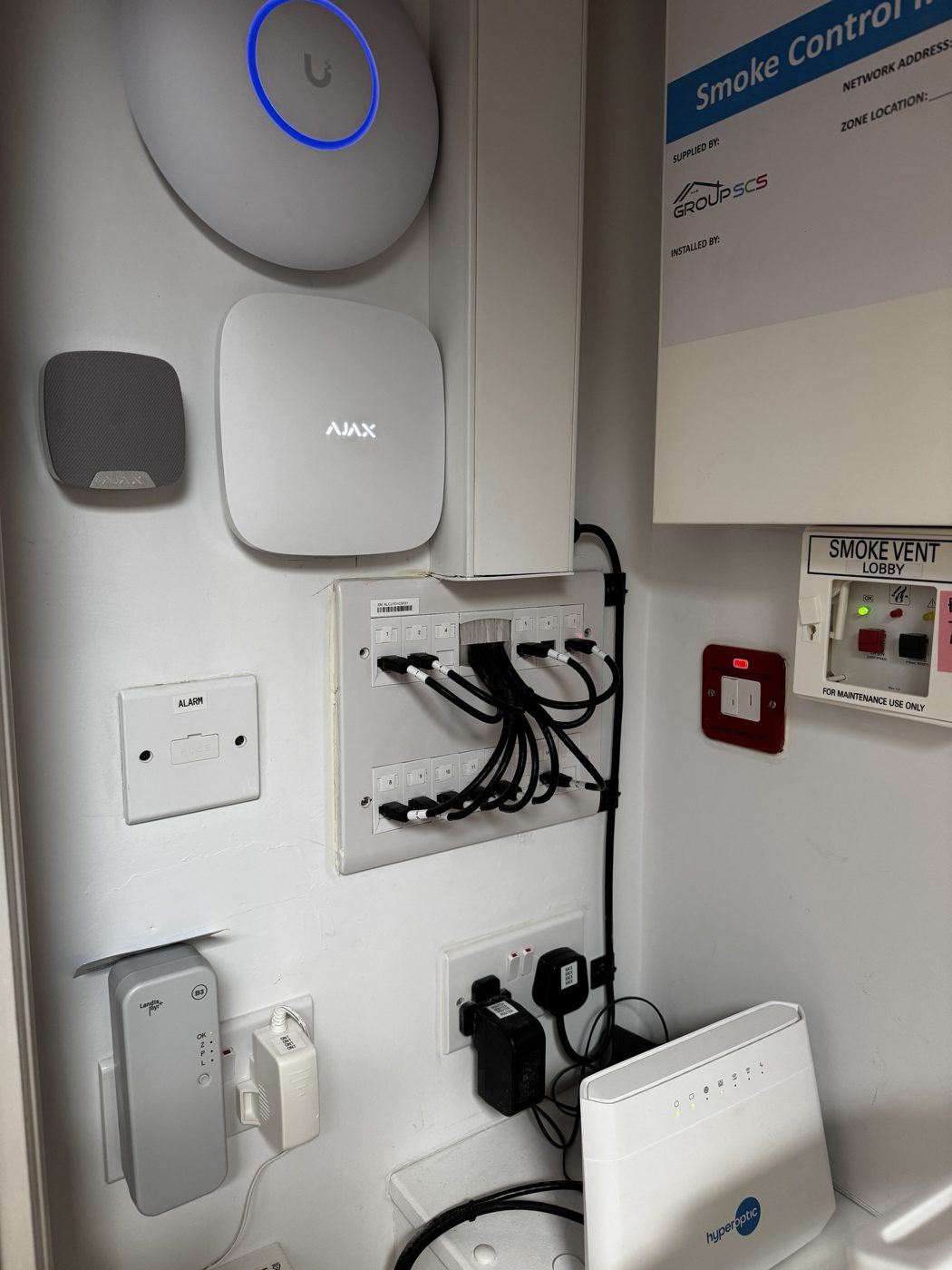
Network, alarm and building systems equipment installed together in a care home comms cupboard

What each system needs

Different systems, different demands on the network.

A network that's fine for guest WiFi can still fail a monitoring sensor in a resident's room. We plan for each type of system explicitly.

Example architecture

Select any part of the network.

Choose a component to see where it sits, the route it takes to the internet, and what matters technically and operationally.

Every home is specified individually. Not every installation includes every system or feature shown here.

Primary WAN

Fibre internet

The main connection to the internet, usually a leased line or full-fibre broadband.

Technical considerations

  • A leased line gives dedicated, symmetrical bandwidth with a provider service level; full-fibre broadband costs less but is shared and best-effort.
  • Sized for the number of devices and the cloud services the home relies on, with headroom for growth.
  • On new builds, fibre lead times can be long, so the order is placed early in the programme.

Operational considerations

  • Many care records, monitoring and communication systems are cloud-hosted, so this connection is a dependency for day-to-day care, not just for residents' WiFi.

Secondary WAN · optional

5G or Starlink backup

A second connection on a different physical path, used if the fibre fails.

Technical considerations

  • 5G depends on local signal strength and may need an external antenna; Starlink needs a clear view of the sky and a suitable roof mount.
  • Backup links usually have less capacity than the fibre, so rules can prioritise care and operational traffic while running on backup.

Operational considerations

  • Whether a home has a backup, which one suits the site, and what it should carry are agreed per project.
  • Where a backup is specified, failover is tested at commissioning.

Edge

Router & firewall

Connects the building to the internet and enforces the security rules between networks.

Technical considerations

  • Terminates the internet connections and, where a backup is fitted, monitors the primary link and switches over when configured to do so.
  • Applies the rules that decide which network segments can reach each other and the internet.
  • Provides secure remote access for management, rather than exposing devices directly to the internet.

Operational considerations

  • One place where security policy is applied and logged, which makes changes and fault-finding quicker.

Core

Core switching & fibre backbone

The comms room switching, with fibre links out to cabinets on each floor or wing.

Technical considerations

  • Fibre uplinks between the comms room and floor or wing cabinets in larger buildings, so distance doesn't limit performance.
  • Edge switches provide Power over Ethernet for access points, cameras and phones, sized with headroom.
  • Power protection and cooling for the cabinets are considered as part of the design.

Operational considerations

  • Tidy, labelled cabinets and accurate records make faults much quicker to find and fix.

Segmentation

Segmented network

Separate logical networks for each category of device, sharing the same physical cabling.

Technical considerations

  • Each category sits on its own VLAN, with its own WiFi network name where wireless is used.
  • Rules between segments are restrictive by default; only the connections a system needs are allowed.
  • Quality of service can prioritise care and voice traffic over streaming.

Operational considerations

  • A resident streaming a film shouldn't slow down a care tablet, and a visitor's phone shouldn't be able to see the CCTV recorder.

Care segment

Care management systems

Digital care planning and records, such as Person Centred Software, used on devices throughout the home.

Technical considerations

  • Needs reliable coverage wherever care is recorded, including residents' rooms.
  • Access to the supplier's cloud service is allowed through the firewall; requirements are taken from the supplier in writing.

Operational considerations

  • The software supplier remains responsible for the system itself. We're responsible for the network it runs on.

Monitoring segment

AI-assisted monitoring

Sensor-based monitoring in residents' rooms, such as the systems used in LNT care homes.

Technical considerations

  • In-room sensors depend on consistent coverage inside bedrooms, often through closed fire doors.
  • Devices sit on their own segment, with only the connections the supplier specifies allowed.
  • A stable internet connection matters where alerts are processed in the supplier's cloud platform.

Operational considerations

  • We provide and support the connectivity. Monitoring configuration, alerting and clinical use stay with the technology provider and the home.

Staff segment

Staff devices

Tablets, handsets and phones carried around the building all day.

Technical considerations

  • Configured for clean roaming between access points, using fast-roaming standards where the devices support them.
  • Authenticated separately from residents and guests; voice traffic can be prioritised.

Operational considerations

  • Device management (apps, updates, lost devices) usually sits with the operator or their IT provider; we make sure the network supports it.

Nurse-call segment

Nurse-call connectivity

Call and alert systems where a dropped connection isn't acceptable.

Technical considerations

  • Some nurse-call systems run on their own wiring or radio; IP-based systems and handset or app integrations depend on the network.
  • Segment, priority, power and any multicast requirements come from the nurse-call supplier and are agreed before installation.

Operational considerations

  • The nurse-call supplier remains responsible for their system; we coordinate the network side and test it with them.

Resident & guest segments

Resident & guest WiFi

Everyday connectivity for residents' video calls, streaming and visitors' devices.

Technical considerations

  • Separate networks for residents and guests, with devices isolated from each other and per-device bandwidth limits where needed.
  • Coverage planned into residents' rooms, not just corridors, for calls and smart TVs.

Operational considerations

  • Good resident WiFi is one of the most visible things families notice, and keeping it separate protects the care systems.

Building segment

CCTV & building systems

Cameras, access control, door entry and building management.

Technical considerations

  • Kept on an isolated segment with no access from resident or guest networks.
  • PoE cameras and recorders are wired, with recording bandwidth kept off the wireless network.
  • Remote viewing or maintenance access goes through a secure method agreed with the system supplier.

Operational considerations

  • Each building system's supplier remains responsible for their equipment; we provide a secure, documented home for it on the network.

Our role

Clear responsibilities, so nothing falls between suppliers.

Care technology projects go wrong when everyone assumes the network is someone else's problem. We're explicit about where our responsibility starts and ends.

We are responsible for

  • The internet connection, backup and failover
  • WiFi coverage and capacity where the system is used
  • Switching, cabling and power over Ethernet for connected devices
  • Network segmentation, security rules and priority
  • Testing connectivity with the supplier before go-live
  • Network troubleshooting once the system is in use

The network itself is delivered through our installation service and looked after through managed WiFi and support.

The technology supplier is responsible for

  • Their hardware, software and its configuration
  • Clinical use, alerting workflows and staff training on their system
  • Their system's compliance and data handling
  • Providing network requirements and supporting joint testing

We don't supply, configure, certify or take clinical responsibility for third-party care software.

Experience

Working alongside care technology providers.

We have experience supporting the connectivity for a range of care technology systems, including:

  • In-room monitoring

    Sensor-based monitoring in residents' rooms, used in LNT care homes on the networks we install, which depends on dependable coverage in every bedroom.

  • Person Centred Software

    Digital care records used on staff devices throughout the home, which need reliable coverage and roaming wherever care is recorded.

  • Other suppliers

    Nurse call, access control, CCTV and building systems from a range of manufacturers.

Names are listed to describe experience and do not imply a formal partnership or endorsement.

How we work with suppliers

A simple, repeatable process.

  1. Gather requirements

    We get the supplier's network requirements in writing — coverage, bandwidth, ports, services and how devices connect.

  2. Design & configure

    We design the network segment and rules for the system and configure them before devices arrive.

  3. Test together

    We test connectivity with the supplier on site before the system goes live.

  4. Support

    If problems arise later, we investigate the network side and work with the supplier to resolve them.

Case study · New build

LNT Care Developments

LNT homes use sensor-based monitoring in residents' rooms, running on the network we install, so in-room coverage is planned room by room.

Example home
Bradshaw Lodge, 66 bedrooms
Wireless
28 × UniFi WiFi 7 access points
Active network install & commissioning
1 working day, 2 engineers
Read the LNT Care Developments case study

Questions

Technology questions

How does care home WiFi support third-party monitoring and care systems?

Each system has its own needs. Monitoring sensors need dependable coverage inside residents' rooms, care-record apps need staff devices that roam cleanly between access points, nurse-call integrations may need priority and specific network settings, and most systems send data to a cloud service. We gather each supplier's network requirements, give their devices a secured network segment with only the access they need, and test connectivity with the supplier before go-live. The supplier remains responsible for its own system.

Do you install or configure care software?

No. The software supplier remains responsible for their system, its configuration and any clinical use. We provide and support the network it runs on, and work with the supplier's technical team to make sure our network meets their requirements.

What do you need from a care technology supplier?

Their network requirements — coverage and bandwidth per room or device, any ports, addresses or services that must be reachable, how devices connect and authenticate, and whether anything needs priority. We then design and configure the network to suit, and test it with them.

Can you help if a care system keeps losing connection?

Yes. We can usually establish whether the problem is in the network — coverage, roaming, configuration or the internet connection — and fix it, or give the supplier clear evidence if it isn't.

Introducing new care technology?

Bring us in early and we'll make sure the network is ready before the devices arrive.