
For care home owners, managers & operations teams
Unreliable WiFi in your care home? We find the cause, then fix it.
From WiFi that drops out every afternoon to a complete network upgrade, we diagnose the problem before recommending anything — and plan the work so residents and staff are disturbed as little as possible.
Does this sound familiar?
The problems we're asked to fix most often.
- WiFi dropping out during the day for no obvious reason
- Slow WiFi when lots of devices are in use
- Dead spots in certain rooms, corridors or wings
- Staff tablets disconnecting part-way through a task
- Care or nurse-call devices losing their connection
- Residents unable to video call family reliably
- Smart TVs buffering or losing their stream
- The whole home going offline when the broadband fails
- No one sure how the network was set up, or who to call
- Repeated complaints from residents, families or staff
In most cases it isn't one single fault, but a network that was never designed for how much a care home now asks of it. The good news is that it's almost always fixable — usually without replacing everything.
How we approach it
Survey, diagnose, recommend — then fix.
You get a clear explanation of what's wrong and what it will take to put right before you commit to any work.
Survey
An on-site wireless and network survey — coverage, capacity, interference, roaming and configuration, measured rather than guessed at.
Diagnose
We identify the actual cause, or causes, rather than treating the most obvious symptom.
Recommend
A plain-English report: what to keep, what to reconfigure and what to replace — with the reasons for each.
Fix
If you'd like us to do the work, it's phased around the home's routine and care operations, and tested as each area is completed.
Not everything needs replacing
Spend money where it fixes the problem.
Some contractors default to ripping everything out. A proper survey tells us what can stay, which often makes the job smaller, cheaper and quicker than a full replacement.
- Often reusable
- Structured cabling, cabinets and containment installed to a reasonable standard
- Sometimes reusable
- Access points, with better placement and configuration
- Usually needs attention
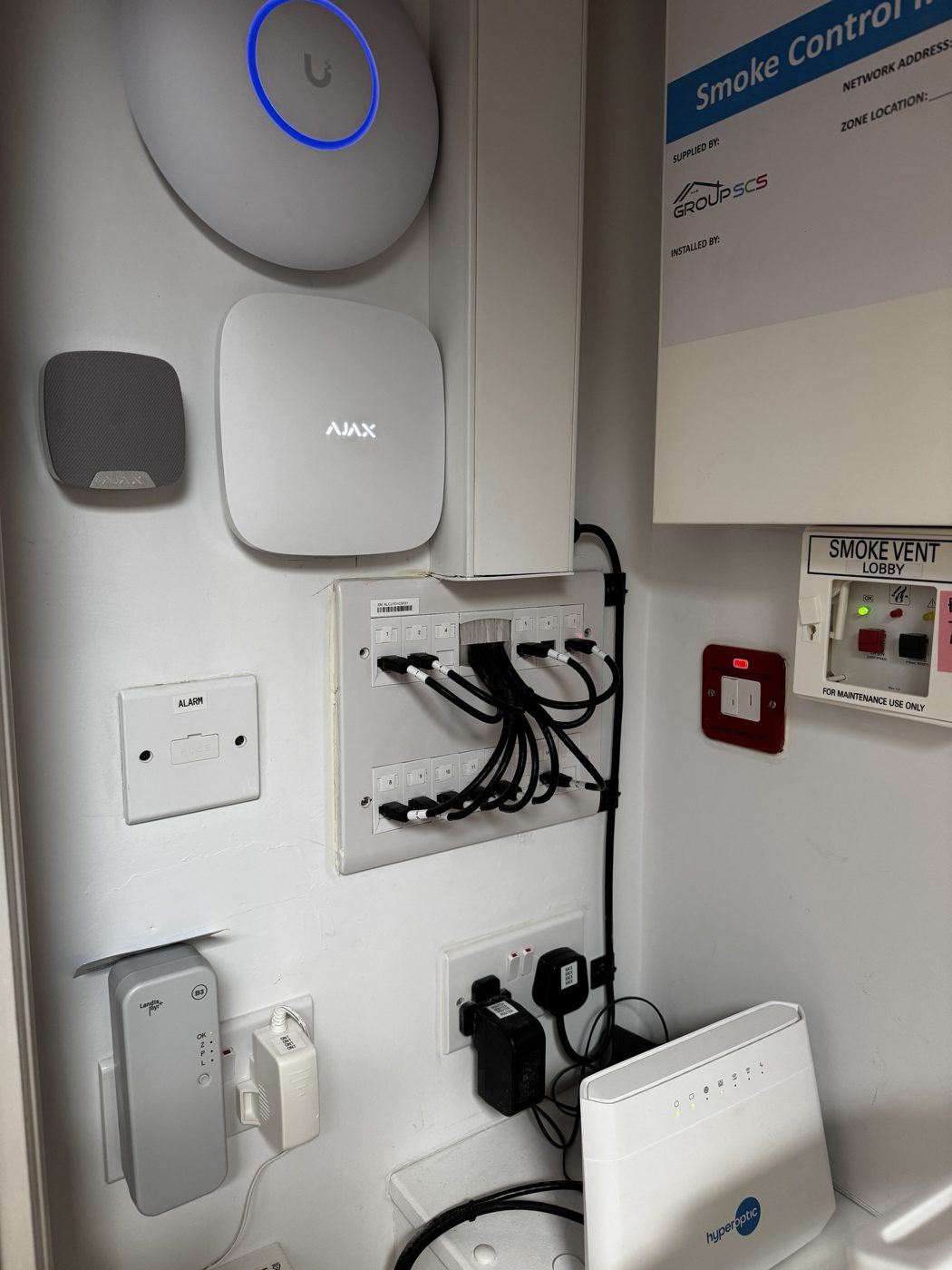
- Network segmentation, switching and PoE capacity, and internet resilience
Staff and resident connectivity
Care systems shouldn't compete with Netflix.
When care tablets, nurse call, residents' phones, smart TVs and visitors all share one network, the busiest traffic wins. We separate them into their own networks, give care and operational systems priority, and keep guest devices well away from anything sensitive.
Phased works
Planned around the home, not the other way round.
Homes are occupied around the clock, so we agree a plan with the manager: which areas first, which tasks need quiet times, and how residents' rooms will be accessed. Each phase is finished and tested before the next starts, so the home is never left part-working.
After the work is done
Ongoing support from engineers who know your building.
We can monitor the network, pick up problems before staff notice them, and handle changes as you add devices or new care technology.
Running more than one home?
Bring every site up to the same standard.
We can survey a group of homes, agree a common design and phase the upgrades across your estate.
Networks for care groupsQuestions
Questions from care home managers
Will we need to replace all our equipment?
Not necessarily. We survey and diagnose the existing network first and only recommend replacing what's genuinely causing the problem. Structured cabling, cabinets and containment can often stay; switching, access point placement and network segmentation are the most common things that need to change.
How disruptive is a WiFi assessment?
The survey is non-intrusive. We walk the building with measuring equipment and look at the comms cupboard and network configuration, scheduled around the home's routine. Any follow-on work is planned with you to avoid disrupting residents, care routines or staff shifts.
Why does our WiFi keep dropping out?
Usually it isn't one fault but a network that was never designed for how much a care home now asks of it — access points positioned for fewer devices, poor roaming between access points, overloaded switching, everything sharing one flat network, or an internet connection that has no backup.
Can you work in an occupied home?
Yes — almost all of our existing-home work happens while residents are in. Work is phased area by area, with noisy or disruptive tasks agreed with the manager in advance.
Can you look after the network afterwards?
Yes. Many homes keep us on for monitoring and support so issues are picked up early by engineers who already know the building.
Find out what's really wrong with your WiFi.
Tell us what's happening and roughly how big the home is. We'll arrange an assessment and give you a clear, honest answer.